“This building is scheduled for demolition as part of a redevelopment project. Residents are asked to vacate voluntarily no later than seven days before construction begins. Failure to do so may result in further action.”
It had been a few days since Dong-jin received the notice. The paper had slid in under the door, a thin thing that crawled through the dark seam between the worn rubber seal and the frame. For a while he left it where it lay. Nothing ever came into the room except dust, insects and mold spores, and the paper seemed lighter and stranger than any of them—an intrusion. Only much later did he get up and pick it up. It was colder than he expected, and dry against his fingers, like a scab peeled from long-hardened skin. He blinked once and read the printed lines twice. Redevelopment. Demolition. Vacate voluntarily. There was not a single unfamiliar word, yet the moment they were put together inside this room, they became another language entirely.
The room had been Dong-jin’s for a long time. At least, that was what he believed. He thought he knew it from beginning to end. The wallpaper had faded through season after season, and fine cracks had crept across the walls. It was as if his breath had caught in every one of them and dried there. The mold had started as specks, spread into stains, and finally swelled like flesh growing where skin should be. Every time it crept a little farther, he felt the cold lining of his lungs draw tighter.
The door had been shut for a long time. It hadn’t always been closed completely, but at some point he had become certain that he would never need to open it again. A door was an exit. An exit implied escape, and escape, he believed, meant ruin. There was no reason to go out. No one was coming in. The world was rotten. In truth, whether it was rotten or not hardly mattered to him; there was no place in it for him to stand, and no place to go back to. The only space that meant anything to Dong-jin was this room. He had always assumed he would be born here and die here. That belief had piled up and hardened until the room became a sealed shell, a carapace that refused all traffic with the outside.
The first crack in that shell was the notice. He looked down at it. A few lines of type stood jammed into the air of the room. Vacate voluntarily. Failure to do so may result in further action. The sentences were dry, but what they meant was far too damp, far too concrete: this room—his world—was going to disappear. As the realization brushed against his chest, he had the illusion that the mold on the walls was very slowly shrinking back. The clammy air seemed to thin, ever so slightly. The trails of slime that had flowed at their steady pace seemed to break somewhere and join again, trembling. Even the hum of damp that filled his ears skipped for a moment, like static. It was as if those few sentences were bending the grain of the whole space, bit by bit.
From that day on, his time split in two: the time before the notice, and the time after he knew he had received it. For a while he folded the paper and pushed it into a corner, then took it out and smoothed it flat again. The number of letters never shrank; the words never changed. Meanwhile the room grew strangely unfamiliar. The distance between the walls, the height of the ceiling, even the amount of dust under the windowsill felt different. The mold in the cracks no longer seemed to stir. It was as if the room’s heart had stopped: the faint, breathing pulse of damp he had felt only the night before was gone.
He often lay on his back on the bed and stared at the ceiling. Sometimes it seemed to be sinking, inch by inch; at other moments it seemed close enough to fall on him and crush him flat. Each breath brought damp to his nostrils, heavier than before. It was like breathing liquid rather than air, as if one more mouthful would flood his lungs. Still he did not get up to open the door. The room was pushing him out, and he only sank deeper inward, as if out of a stubborn resolve to bear that pressure to the end.
Scheduled for redevelopment. Scheduled for demolition. He turned the words over and over in his mind. They told the room’s fate, and at the same time they seemed to pronounce his own. That he would be discarded at the very moment the room was torn down—this strange simultaneity struck him as a fact beyond doubt. It was just as that thought passed through the pit of his stomach.
At first it was only a small discomfort, the kind of twinge that comes with hunger and goes. Dong-jin thought nothing of it. But the pain soon showed what it was. Something inside seemed to be turning, slowly, and shifting its position. A chill rose from somewhere deep and wrapped around his whole belly, as though a sliver of ice had lodged in his flesh and was steadily growing. Without meaning to, he doubled over and pressed both hands to his stomach. Under his palms it felt the same as always—the same warmth, the same texture as yesterday. But beneath that single layer of skin there was clearly something else. A hardness he could feel but not touch. A strange density, unlike bone.
He traced his fingers slowly around his belly but found nothing. Instead the pain sank deeper. It felt as if some creature were growing inside him, slicing and biting at his organs. A slow, relentless terror bore down on him, as though a new life and the host it was steadily eating away were sharing the same space at once.
The air in the room convulsed with him. The smell of mold grew suddenly thicker. With every breath it seemed to be growing straight into his lungs. His vision began to swim. The walls drew back, the ceiling floated away, and the floor tilted in ways he could not follow. His legs gave out and he crumpled to the floor. Cold slime flattened slowly beneath him. As he let out a last breath, the chill in his belly drove in deeper still. And with the sense of falling into somewhere very deep and very dark, everything went black.
He had no idea how much time had passed. When a stabbing pain somewhere in his body stirred again, he slowly opened his eyes. The room was still quiet—a stillness so close to silence that quiet was not the word. The air was still heavy. Each breath snagged briefly somewhere in his throat. He gritted his teeth and tried to sit up. At once the chill surged up from his belly again, as if something were trying to push its way out. He froze and made his breathing as shallow as he could.
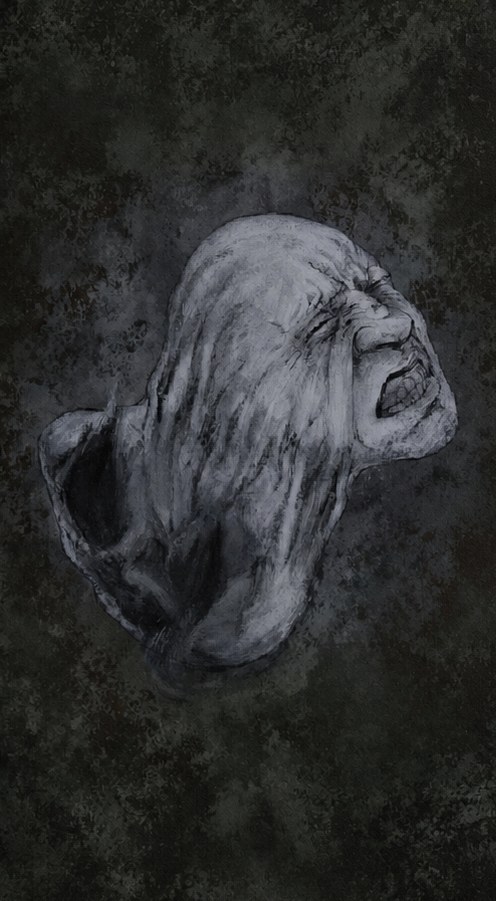
Then something in the corner caught his eye. In the shadow where the wall met the floor, among old blotches of mold, there it was. At first he took it for a ball of dust. He narrowed his eyes and tilted his head. Where the faint light touched it, the surface glistened like a wet membrane. Inside the clear membrane something was curled up. He shut his eyes for a moment and opened them again. It was too distinct to write off as a hallucination of exhaustion and pain.
Inside the membrane, something moved, very slightly. The surface quivered and a small crack appeared. Dong-jin held his breath. Without a sound the crack widened, and a cloudy slime oozed out. When the membrane split open completely, a round, wet lump emerged. At first it looked like a mass of flesh with almost no shape at all. He could not look away. The lump turned slowly. Its slime-coated surface twisted, contracting and stretching by tiny degrees. A small but unmistakable life. It felt as if all the time in the room had changed its rhythm to keep pace with that movement.
It was alive. He did not take long to admit it. Life is proved by movement and warmth, and this had both. Instinctively he looked down at his own belly. The strange chill that had been writhing inside him seemed suddenly fainter. His belly felt hollow, like the place something had just left, holding nothing but a dull, heavy ache. He looked again at the thing in the corner. It seemed to be flesh that had certainly been cut from somewhere, yet belonged nowhere at all. A “something” he had given birth to. After a moment’s hesitation he tried a name for it in his head: snail. As soon as he named it, its outline began to emerge. A bloated body, slime running over moist flesh, the beginnings of a thin shell not yet properly coiled. Perhaps it had been a snail all along, and he had simply been slow to see it.
The snail grew at an astonishing rate. By the next day it had ventured into the middle of the room, left a trail of slime and gone back; by the second day it was creeping slowly around the bed legs, under the sink and past the shoe rack, making its presence known. Within a few days its round, wet body had swollen to fill nearly half the room. The shell, now beginning to coil into a spiral, was at first as soft and pliant as cartilage, but it hardened little by little. Dong-jin watched it happen—sometimes right in front of him, and sometimes, as he sat on the bed staring blankly at the ceiling, his eyes would drift back to the snail of their own accord.
The slime came thicker and faster. New channels branched and merged across the floor, as if the room were a body whose organs were rearranging themselves. Dong-jin stepped over them with care: the cold slickness under his soles, and within it a faint tremor. He was afraid of the snail, and yet he felt something close to awe. It had unmistakably come from part of himself—his pain, leaked out, set hard and grown into a creature of its own. It was also the knot at the center of this place, made of the room’s damp and mold, its wallpaper and dust, all tangled together. More and more he felt he could call the snail, rather than the room, his room.
Then one day the walls began to shake. At first there was only a low, dull rumble, as if a neighbor were dragging something heavy across the floor. Soon a sharper vibration bored into the walls: the sound of a drill biting into concrete. The demolition had begun. The shriek of wallpaper, mold and old layers of cement being ground away together carried right into the room. The ceiling trembled faintly, and long-settled water stains and clumps of dust fell one after another. The room looked like a huge animal writhing and oozing mold and slime.
Dong-jin stood in the middle of the room, looking from the walls to the snail and back. The drilling was getting closer. Sooner or later this room, this mold, this whole mass of heat and damp would be cut away and hauled off as rubble on the back of a truck. The moment when the outer skin of the only world he knew would be peeled away whole. He thought about what he had left. The bed? The furniture? A few shabby clothes? None of it could be called a world. The only living thing was the snail.
He stood before its shell. Inside the coiled spiral, soft flesh clung to the walls and stirred faintly. The slime caught the light and glimmered dimly, and whenever that light fell across the back of his hand, the grain of his skin, his old cuts and scars, stood out as if they belonged to someone else. He ran his fingertips gently over the shell. It was neither cold nor warm, yet there was a definite warmth of life in it. The shell was hard, but it held a springiness that pressed out gradually from within, as if another room, another world, lay coiled inside. He had the thought that he could hear his own heartbeat in there. No—when he put his ear to it, he really could. A heavy pulse echoed out from between the turns of the spiral.
Only then did he understand. This enthralling shell was the house he had to move into now. Even if the room fell, even if it was torn down and cut to pieces, as long as this shell remained, there would still be one world that had not vanished completely. He closed his eyes for a moment. Outside, things were still breaking, falling, piling up. The sound of the world being slowly taken apart.
Looking down at the snail, he whispered that he was sorry. They were words he had never really said before—to anyone, anywhere, perhaps not even to himself. He could not tell whether the snail understood. Its huge body stopped moving, and the front of it, the part that might have been a face, drew back very slightly. In that moment, his mind was made up.
Dong-jin took hold of the shell’s rim with both hands. At first it didn’t seem to give at all. But when he pulled harder there was a small, sticky sound, like living flesh being torn away. He clenched his teeth and pulled again. Where shell met body, the slime stretched into long strands. In the damp room the sound of tearing and the snail’s low moan blurred together and spread like something heard in a fever. The shell was harder than he had expected; each time a piece came away, a shudder ran into his palms. Slime ran down his wrists and left streaks all the way to his elbows and shoulders.
He didn’t stop. The more of the shell he peeled away, the deeper his hands sank into the snail. Soft, cold flesh slid between his fingers. Somewhere he could feel the snail’s body trembling, and something like breath seemed to escape between the tremors. When he gathered the last of his strength and tore the shell away completely, the room was coated in slime. The bottoms of the walls, the floor, the legs of the bed, even his own ankles and calves were slick with the snail’s traces. Stripped of its shell, the snail lay face down on the floor like a limp heap of flesh. It did not move again.
Dong-jin gathered the shell into his arms. It was heavier than he had expected. But rather than dragging him down, its weight seemed, strangely, to lift him from within. Carefully he leaned toward its opening. The coiled interior was sticky and warm. The slime clung to his skin and slowly began to soak in. With each step he took, he felt a little more surely that he was passing from the room into the snail, from the snail into the shell. When he had gone in so far that he could no longer tell where his skin ended and the shell’s inner wall began, he curled up, quietly caught his breath, and settled back against the inside.
Soon the shell began to merge with his flesh. The slime erased the edges of his skin and rearranged his body along the curve of the spiral. Arms and legs, spine and ribs folded and overlapped in new ways, like an old piece of furniture taken apart and rebuilt to fit a smaller room. He closed his eyes slowly. The sounds of destruction outside grew more and more distant. Walls caving in, the ceiling splitting, the floor breaking apart—all of it passed through the shell’s thick flesh and became a dull vibration. When the last slab of concrete broke away, the room breathed out dust and mold one final time, like a dying breath. But none of it could reach the inside of the shell anymore.
Inside the shell he heard nothing. Or rather, the only thing he was sure of was that there was nothing to hear. He fell asleep in a dark sea of slime. One by one, scenes from the past were drawn in and sank toward the center of the spiral: the bed and the wallpaper, the old sink and the dusty windowsill, the gap under the door where the notice had been. Everything blurred. The outside world slowly lost its lines, its colors, its meaning. All that remained was a narrow, deep passage winding inward. And at its center, his heart began to beat in time with the pulse of the shell.
Meanwhile the stripped snail began, slowly, to move. All it had left now was the soft foot pressed against the floor where its shell had been. With great effort it raised itself and turned toward the exit, which had not yet entirely collapsed. Slime trailed out beneath it, drawing a new line across the room. Over the path that had once been his blood vessel and the room’s, one last trail continued. Shell-less, the snail made its way very slowly, but unmistakably, out of the room.
Inside the spiral shell, Dong-jin smiled quietly. He could hardly feel whether the muscles of his face were moving, but somewhere a smile was spreading. Outside there must have been the noise of demolition, the smell of dust and rubble, people shouting orders and curses. None of it reached him now. He remained curled inside a single shell, a single carapace, a single spiral room.
When the last of the rubble had been cleared away and the place where the room had stood was an empty lot, it seemed that nothing was left there at all. But somewhere deep and out of sight, along the walls of the shell, a thin, slow pulse of slime went on.
His world was complete once more.